
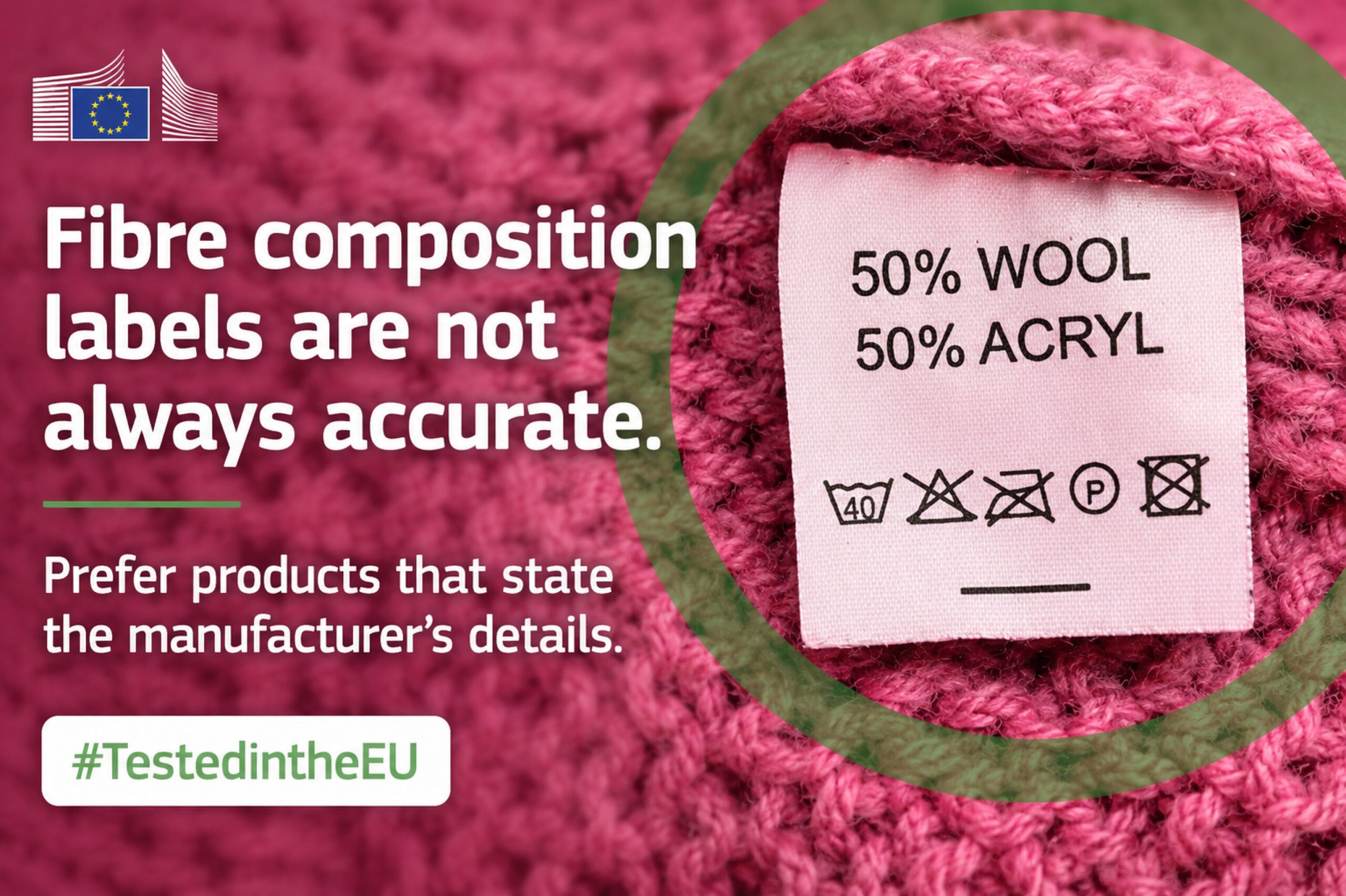
Inaccurate clothing labels: a systemic issue
As part of the 2025 Joint Actions on Compliance of Products (JACOP) campaign, supported by the European Commission’s Directorate-General for Internal Market, Industry, Entrepreneurship and SMEs (DG GROW), market surveillance authorities conducted spot checks across 11 product categories, one of which focused on clothing products.
Sampling
Sampling was carried out by market surveillance authorities (MSAs) in Cyprus, Denmark, Finland, Germany, Italy, Lithuania, Malta and Portugal, involving the purchase of 104 clothing items from physical retail stores and 28 items online. In total, 132 samples were tested, comprising 44 T-shirts/tops, 36 baby garments, 15 sportswear items, 12 sleepwear items, 5 scarves and 20 other types of clothing. The samples included products made from wool, cotton and fibre blends.
Findings
Testing conducted by an accredited laboratory in Italy revealed a 46% non-compliance rate for products purchased online (including via retailers’ own websites) and 36% for products purchased in physical stores.
Many products, particularly those imported from countries outside the EU/EFTA, lacked essential manufacturer information, making enforcement and product recalls more difficult. Overall, 49 samples (37%) were found to have labels that did not accurately reflect their actual fibre composition.
Three main types of non-compliance were identified:
- The fibres were correctly stated on the labels, but the percentages did not correspond to the actual composition of the products.
- The products contained different and cheaper fibres than those declared on the labels.
- The fibres were incorrectly declared or incorrectly named.
The highest rates of non-compliance were recorded for scarves, T-shirts/tops and baby garments, with failure rates of 80%, 54% and 25%, respectively. Lower failure rates were recorded for the other categories tested: sportswear (13%), sleepwear (16%) and other clothing items (40%).
In terms of fibre composition, samples labelled as containing a blend of natural and man-made fibres showed the highest failure rate of 64%, followed by samples labelled as containing a blend of natural fibres (46%). Products labelled as “100%” of a single natural fibre recorded a non-compliance rate of 15%.
Market surveillance authorities (MSAs) highlighted that such cases of non-compliance pose significant financial risks to consumers, undermine fair competition and make recycling more difficult, as accurate identification of fibre composition is essential for effective textile recycling.
Corrective action
Market surveillance authorities ordered the withdrawal from sale of 18 products. Manufacturers of two products were instructed to take corrective action, while two other products were required to be relabelled.
For three products, economic operators were instructed to provide the items with the appropriate warnings. As of early March 2026, corrective measures were still ongoing for 24 products.
A total of 41 products were registered in the Information and Communication System for Market Surveillance (ICSMS), the EU platform used by market surveillance authorities to exchange information on product testing and findings of non-compliance. The system supports coordinated enforcement and helps authorities address unsafe and non-compliant non-food products on the market.
Recommendations
The high non-compliance rate indicates that incorrect labelling remains a widespread issue, highlighting the need for continued product testing and greater industry awareness about correct labelling obligations.
Consumers purchasing clothing are advised to exercise caution when faced with very low prices or offers that appear too good to be true. They should also favour products whose labels provide the name, address or website of the manufacturer, helping to ensure accountability and traceability.
Importers, distributors and retailers should verify that the required labels and markings are present on all products.
Both businesses and market surveillance authorities should ensure that rigorous testing is carried out on finished garments as well as fabric rolls.
Vanessa Capurso, Policy Officer at the European Commission’s Directorate-General for Internal Market, Industry, Entrepreneurship and SMEs (DG GROW), said: “Consumers and businesses need to know that the labels on the garments they buy give a true picture of the fibre composition of those garments. Market surveillance campaigns help ensure consumers get what they pay for and protect businesses from unfair competition”.
Learn more about the EU Market surveillance: https://single-market-economy.ec.europa.eu/single-market/goods/building-blocks/market-surveillance_en
