
Sustainable Textile Dyeing: Green Technologies for a Cleaner Textile Industry
The textile dyeing sector remains one of the most resource-intensive and environmentally challenging industrial activities worldwide due to its high consumption of water, thermal energy, salts, alkalis, surfactants, and synthetic dyes, as well as the generation of large volumes of contaminated wastewater. Conventional aqueous dyeing processes operate under high liquor ratios and elevated temperatures, resulting in significant carbon emissions and severe environmental burdens on aquatic ecosystems.
The reviewed scientific article “A Comprehensive Review of the Advances in Process Engineering and Greener Solvents in Dyeing to Impart Sustainable Textile Manufacturing” by Mohammad M. Hassan presents an in-depth overview of recent advances in sustainable dyeing technologies aimed at reducing the environmental footprint of textile manufacturing while maintaining acceptable dyeing performance and colourfastness. The study critically compares sustainable aqueous dyeing methods and waterless dyeing technologies in terms of process efficiency, industrial feasibility, solvent recovery, environmental performance, and applicability across different fibre types.
Low-resource aqueous dyeing methods such as rapid dyeing, low-temperature dyeing, low-liquor-ratio dyeing, ultrasound-assisted dyeing, foam dyeing, transfer dyeing, gel dyeing, and closed-loop dyebath recycling systems demonstrate significant reductions in water, energy, and chemical consumption. Techniques such as sonication improve dye diffusion into fibres, while low-liquor-ratio systems substantially reduce wastewater generation. Closed-loop dyeing systems based on dyebath reuse and decolourisation technologies offer additional opportunities for reducing freshwater demand and lowering the carbon footprint of textile wet processing.
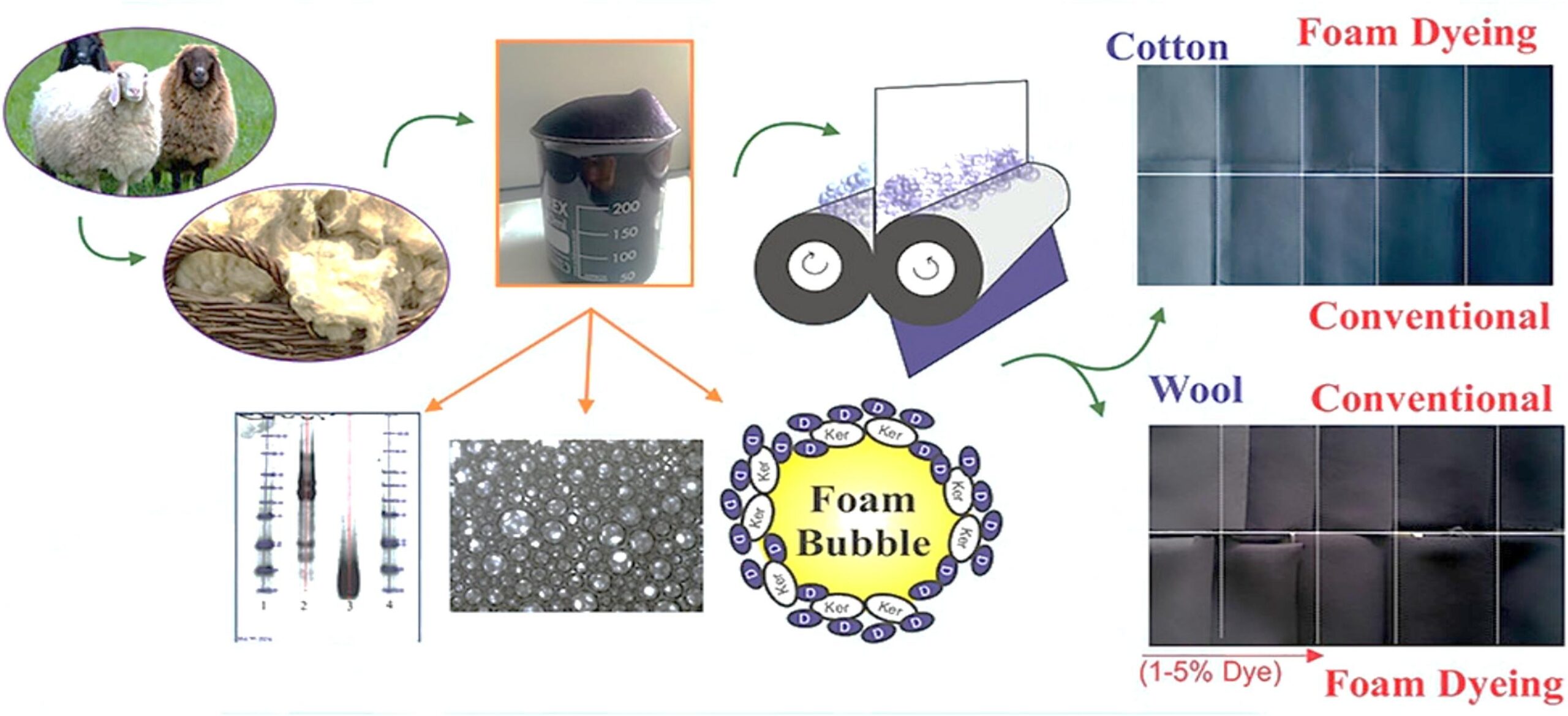
Figure: Foam dyeing of textiles with reactive and acid dyes
The article also examines zero-effluent waterless dyeing technologies, including solvent dyeing, reverse-micellar dyeing, dyeing in ionic liquids (ILs) and deep eutectic solvents (DESs), silicone-oil dyeing, and supercritical carbon dioxide (scCO2) dyeing systems. Among these technologies, reverse-micellar dyeing emerged as one of the most promising alternatives for natural and polyamide fibres, enabling dye transfer through microemulsion systems with extremely low water usage and good colourfastness performance.
Supercritical carbon dioxide (scCO2) dyeing was identified as the most industrially mature and environmentally effective waterless dyeing technology, particularly for polyester fibres dyed with disperse dyes. The process eliminates wastewater generation, reduces drying energy demand, and enables efficient dye penetration due to the unique physicochemical properties of supercritical CO2. Polyester fabrics dyed in scCO2 demonstrated excellent colour yield, levelness, and washing and rubbing fastness. However, the application of scCO2 remains limited for cotton, wool, and other hydrophilic fibres because conventional reactive and acid dyes are not readily soluble in the supercritical medium.
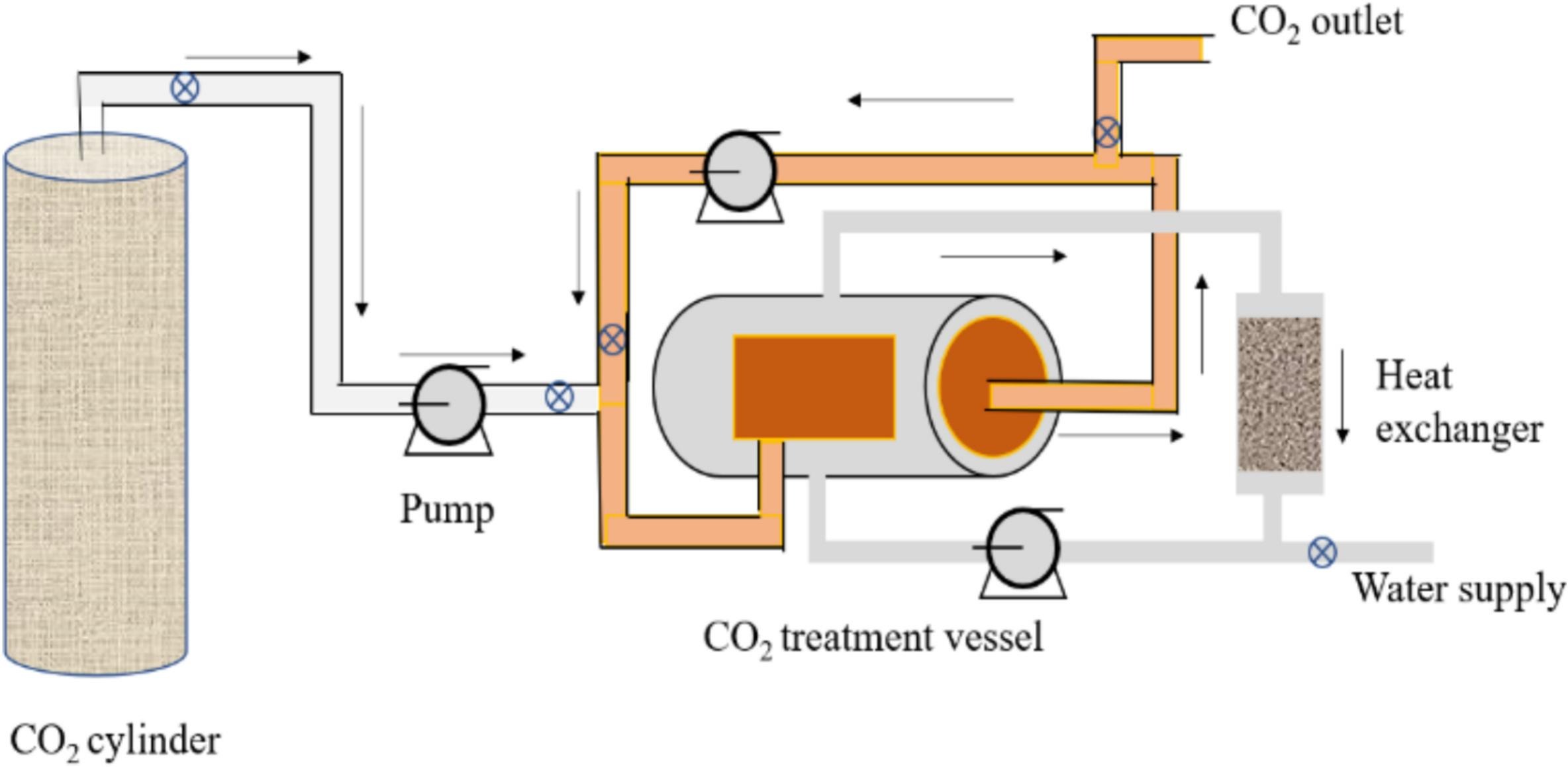
Figure: Diagram of a supercritical carbon dioxide (scCO2) dyeing machine
The review further highlights that ionic liquids and deep eutectic solvents can improve dye uptake and reduce electrolyte requirements, although industrial implementation remains restricted by solvent toxicity, viscosity, recovery difficulties, and high operational costs.
A major conclusion of the study is that no single sustainable dyeing technology currently satisfies all environmental, economic, and industrial requirements for every fibre and dye class. Each technology presents trade-offs between sustainability, dyeing performance, scalability, solvent recovery, safety, and cost.
The authors identify several future research priorities, including:
- development of non-toxic and recyclable green solvents,
- design of novel reactive disperse dyes compatible with non-aqueous systems,
- optimization of closed-loop recycling technologies,
- development of biodegradable and bio-based dyes,
- adaptation of industrial dyeing machinery for solvent-based systems,
- and integration of artificial intelligence and advanced process engineering tools to accelerate sustainable textile innovation.
The review demonstrates that although major progress has been achieved in sustainable textile dyeing, further technological development, industrial scaling, and economic optimization are necessary before truly circular, low-carbon, and zero-effluent dyeing systems can become widely adopted within the global textile industry.
Read the Full article here: https://www.sciencedirect.com/science/article/pii/S2214993725002581#f0050
