Corporate Sustainability Reporting in the European Union
Introduction
In recent years, the European Union (EU) has integrated sustainability into several levels of governance. This has rendered business reporting more transparent and accountable. The objective of these initiatives is to encourage businesses to adhere to the European Green Deal and the overarching aim of achieving global climate neutrality by 2050. This legal amendment mandates thousands of organizations to disclose their sustainable practices, significantly augmenting the volume and variety of information required for reporting.
This knowledge article draws on insights from the paper “An Overview of Corporate Sustainability Reporting Legislation in the European Union” by Hummel and Jobst (2024) to provide an overview of the EU’s sustainability reporting framework, its evolution, and the main legislative instruments shaping current practices.
From NFRD to CSRD: Expanding the Reporting Landscape
The first legislative step towards mandatory non-financial reporting in the EU was the Non-Financial Reporting Directive (NFRD), adopted in 2014. It applied to large public-interest entities with more than 500 employees, requiring disclosure on environmental, social, human rights, and anti-corruption matters. Although it marked a major development, the directive was criticized for its limited scope and insufficient comparability of information.
These shortcomings led to the adoption of the Corporate Sustainability Reporting Directive (CSRD) in 2022. The CSRD introduces more detailed and standardized reporting obligations and extends coverage from approximately 11,700 companies under the NFRD to nearly 50,000. It also requires disclosures in line with European Sustainability Reporting Standards (ESRS), which define uniform criteria for reporting content.
Core Elements of the CSRD
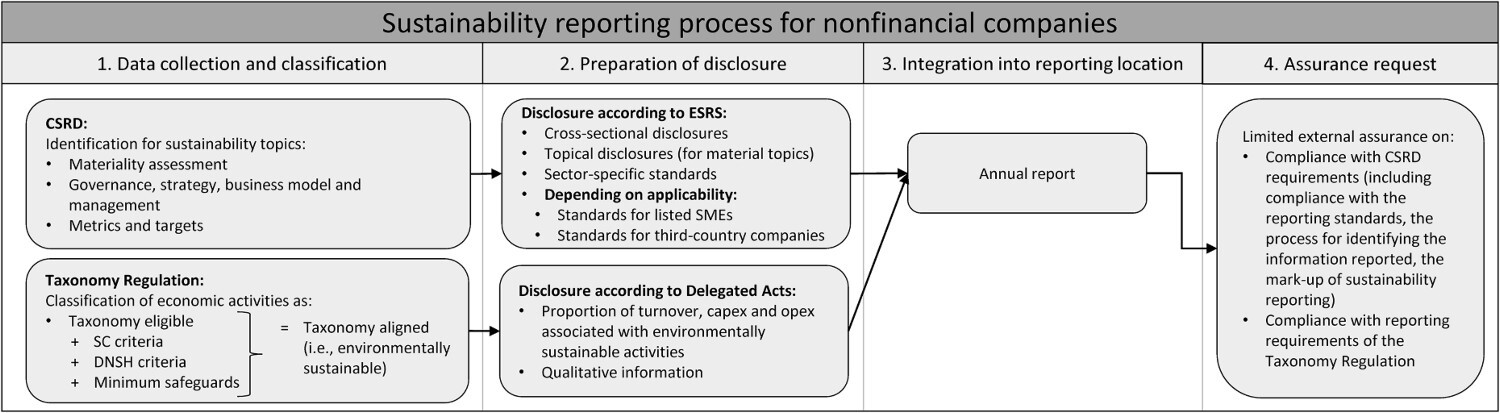
The CSRD aims to enhance transparency, comparability, and reliability of sustainability information. Key features include:
- Double Materiality: Companies must assess both the financial impacts of sustainability issues on their operations and their own impacts on society and the environment.
- Integration with Management Reports: Sustainability information must form part of the management report rather than a standalone document.
- Digital Tagging: Reports must be prepared in a machine-readable format to ensure accessibility and alignment with the European Single Access Point.
- Assurance Requirement: Initially, a limited assurance engagement is required, with a possible shift to reasonable assurance in future stages.
- Related Legislative Pillars
The CSRD is supported by a broader regulatory framework designed to foster sustainable finance and responsible business practices.
EU Taxonomy Regulation
The EU Taxonomy, implemented in 2020, provides a classification system for economically sustainable actions. It outlines six environmental objectives, encompassing ecosystem preservation and climate change mitigation. Entities governed by CSRD must disclose the proportion of their revenue and investments aligned with these objectives.
Sustainable Finance Disclosure Regulation (SFDR)
The SFDR focuses on financial institutions, requiring them to integrate sustainability risks into their decision-making and to report on adverse impacts. It also classifies financial products according to their sustainability characteristics, creating greater transparency for investors.
Pillar 3 Disclosures
Large banks and investment firms listed in the EU must report climate-related risks under Pillar 3 of the Capital Requirements Regulation (CRR II). These disclosures aim to increase market discipline and ensure that financial stability considerations incorporate environmental risks.
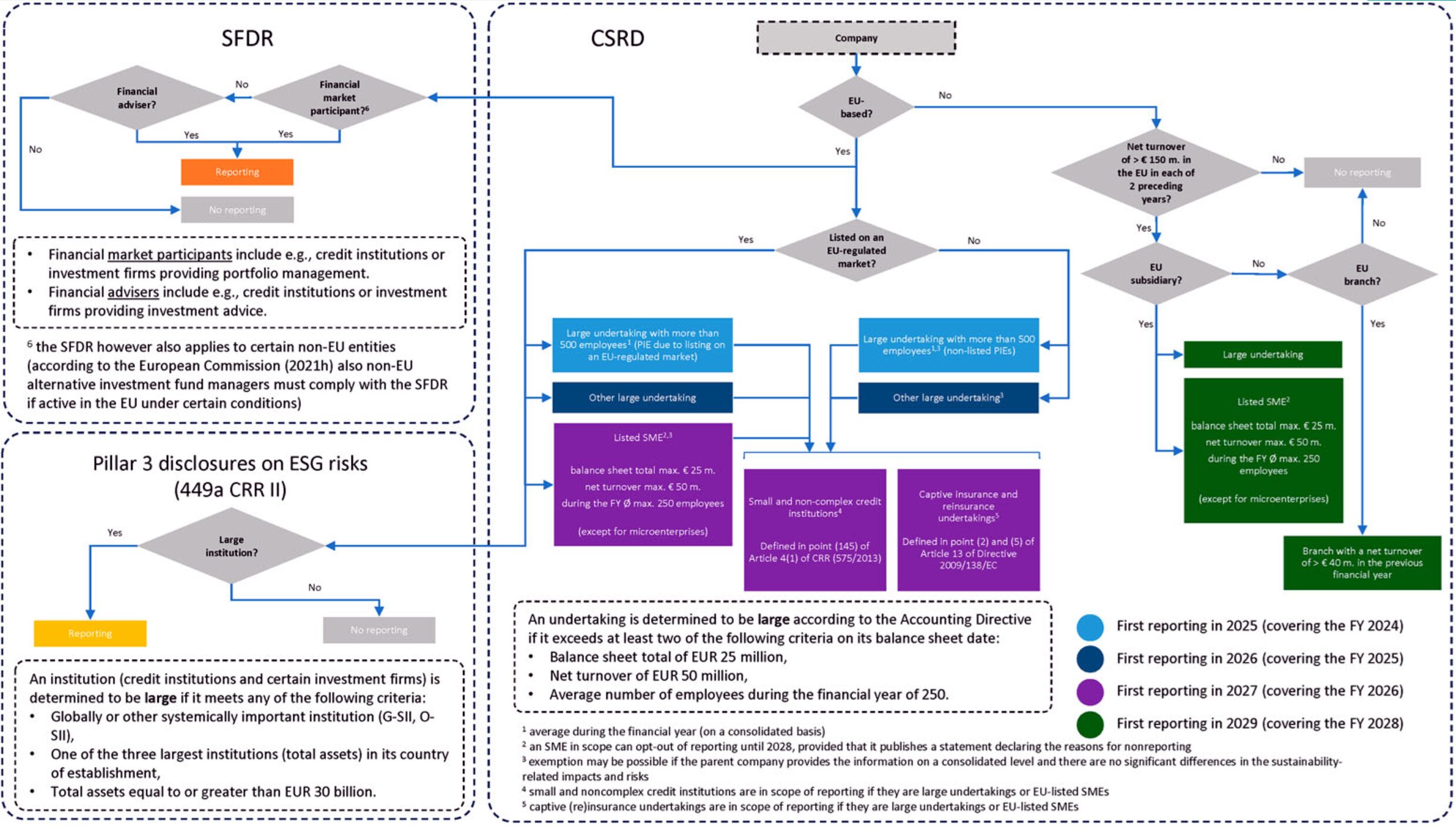
Decision tree for reporting according to the CSRD, SFDR and Pillar 3 disclosures on ESG risks. (Hummel & Jobst, 2024) (Hummel & Jobst, 2024) distributed under CC BY-NC-ND 4.0
Decision tree for reporting according to the CSRD, SFDR and Pillar 3 disclosures on ESG risks. (Hummel & Jobst, 2024) (Hummel & Jobst, 2024) distributed under CC BY-NC-ND 4.0